
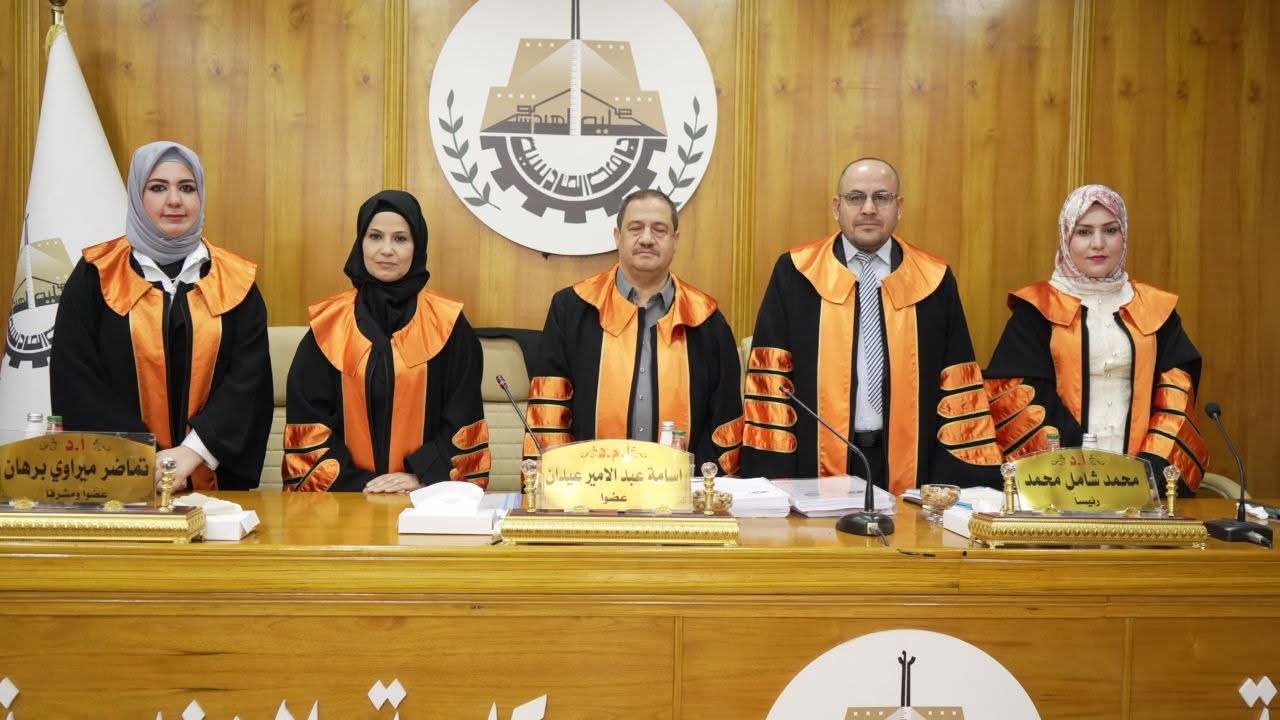
The Department of Civil Engineering at the College of Engineering, Al-Qadisiyah University, discussed a Master’s thesis entitled “Production of Limestone and Calcined Clay Cement Concrete from Locally Available Materials,” submitted by researcher Zahraa Tahseen Hamza and supervised by Professor Dr. Tamadher Mirawi Burhan.
The thesis aimed to study the feasibility of using locally available Iraqi limestone and kaolin-rich clay to produce calcined limestone and clay cement concrete (LC3) as a more sustainable alternative to traditional cementitious materials. It also investigated the effect of the degree of heat treatment of the kaolin and the composition of the binder on the physical and mechanical properties, durability, and environmental performance of LC3 concrete.
The results showed that mixtures containing kaolin calcined at 750°C achieved better performance than mixtures containing kaolin heat-treated at 400°C in terms of compressive strength, reduced porosity, water absorption, and improved stability. Dimensional properties and resistance to chloride and sulfate exposure
The results also showed that LC3 mixes contributed to a reduction in estimated carbon dioxide emissions ranging from 45% to 50% compared to traditional mixes based on Portland cement. This confirms the potential for utilizing local Iraqi materials to produce more sustainable concrete while reducing clinker consumption and the environmental impact of the cement industry.
The study concluded that using locally available materials in Iraq could provide a promising avenue for producing LC3 concrete with satisfactory mechanical performance and durability, particularly in aggressive environments, thus supporting sustainability goals and the development of environmentally friendly construction materials.

No comment