
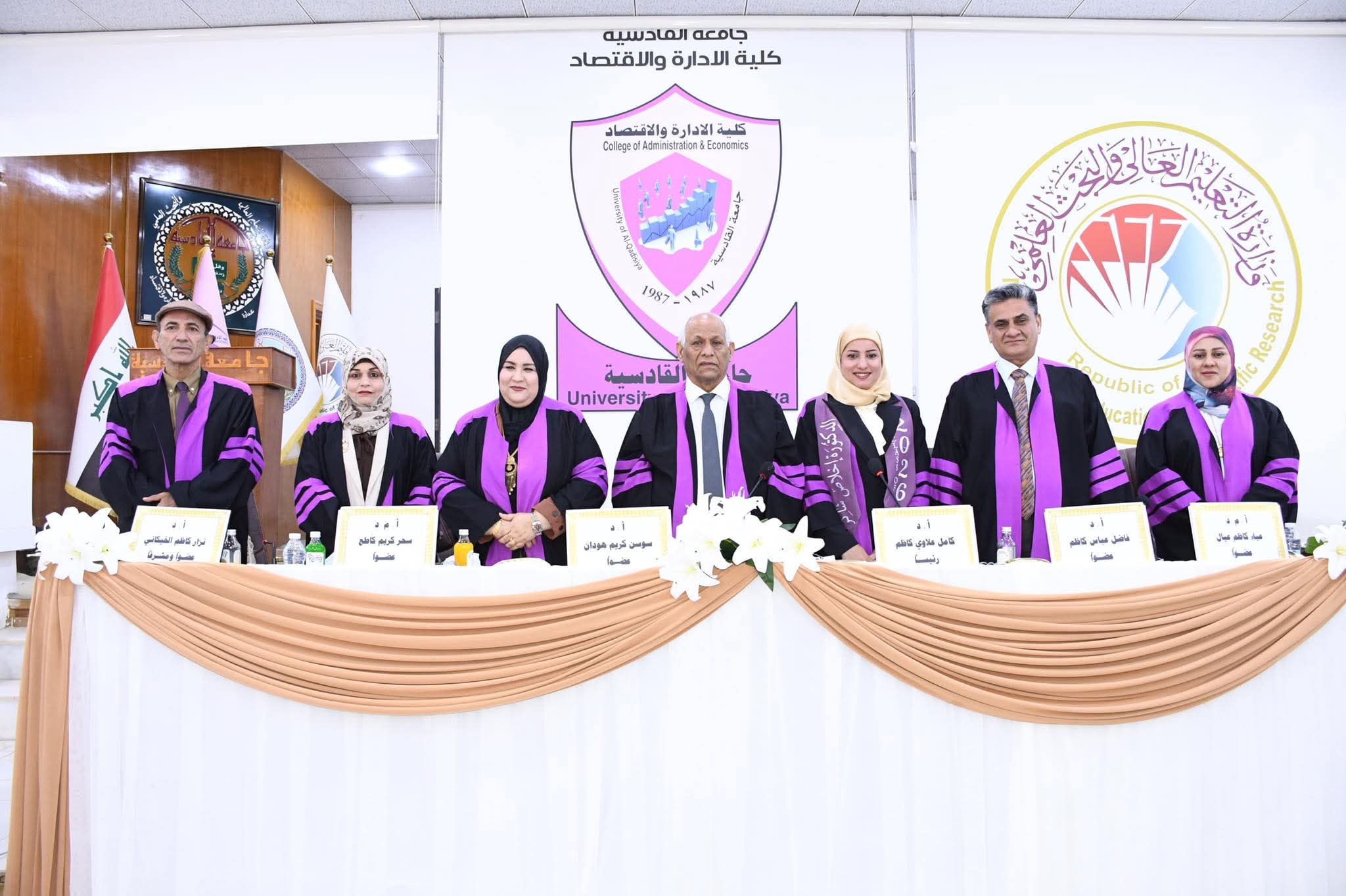
The Department of Economics at the College of Administration and Economics, Al-Qadisiyah University, discussed a doctoral dissertation entitled “The Response of Monetary and Banking Stability to Changes in Fiscal and Monetary Policies in Iraq for the Period (2003-2023)” by researcher Ikhlas Shaker Omran Al-Fatlawi, supervised by Professor Dr. Nizar Kadhim Sabah Al-Khaikani.
The study aimed to highlight the effectiveness of fiscal and monetary policies in achieving monetary and banking stability in Iraq, as well as to identify the response of monetary and banking stability indicators to changes in fiscal and monetary policies during the period (2003-2023) by understanding and clarifying the fundamental changes in the tools and variables of these policies and their resulting effects on monetary and banking stability.
The most important conclusion is that monetary and banking stability indicators have a statistically significant but not comprehensive response to changes in fiscal policy; that is, a response The partial significance of these indicators stems from the limited and weak impact of fiscal policy variables, which are less responsive than monetary policy changes with a broader, more significant impact. This is due to the proven and strong statistical effect of monetary policy variables, reflecting the dominance of monetary instruments in explaining monetary and banking stability in Iraq. The study concludes that coordination between fiscal and monetary policies is essential, along with comprehensive reform of both, to ensure monetary and banking stability in Iraq.


No comment