
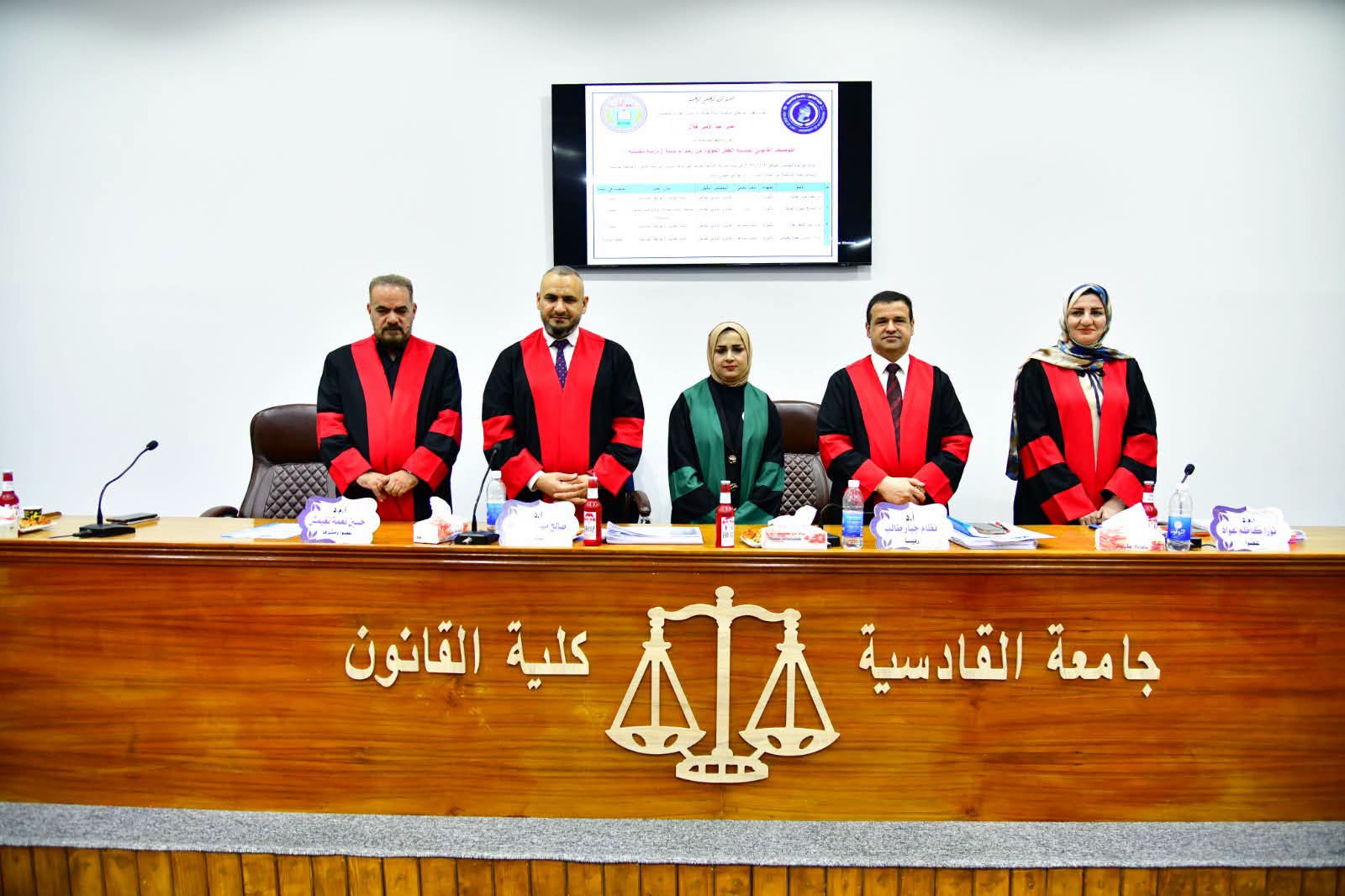
A Master’s thesis entitled “The Characterization of a Child Born to a Mother Who Has Been Excluded from the Family – An Analytical Study” by researcher Ghadeer Abdul-Amir Hilal, supervised by Assistant Professor Dr. Hussein Naama Nughaimish. was presented at the College of Law in Qadisiyah.
This thesis aims to define the nationality of a child born to a surrogate mother, highlighting one of the subtle points that indicate this compatibility among nationals. This compatibility represents a percentage among nationals and entails a set of rights and obligations that define them through nationality. Individuals with this nationality receive protection and diplomatic status, and they enjoy civil, political, and social rights, while simultaneously being bound by specific mechanisms defined by national laws. The thesis also addresses the responsibilities of international laws and agreements, which has led to a significant deficiency in the determination and proof of nationality due to a lack of awareness of these details within the state and the protection of human rights.
The thesis chooses to differentiate between the nationality of a child born to a surrogate mother, distinguishing between congenital and acquired homosexuality, based on social considerations that are often overlooked in the country whose nationality the child seeks. Furthermore, the issue of establishing the nationality of a child born to a surrogate mother in Iraqi law is influenced by multiple factors, due to the absence of a clear legal text clarifying this situation.
The study recommended that the center regulate the birth of a child through surrogacy techniques, based on legal texts and procedures, relying on the principle of blood rights as a basis for granting citizenship without requiring specific criteria. This approach addresses the clear reproductive methods used by many people, or the differing legal opinions, and establishes specific criteria for surrogacy and egg donation in certain cases. This includes determining the type of maternal lineage and gender, ensuring compatibility with the child’s preferences and preventing them from being born out of wedlock.

No comment