
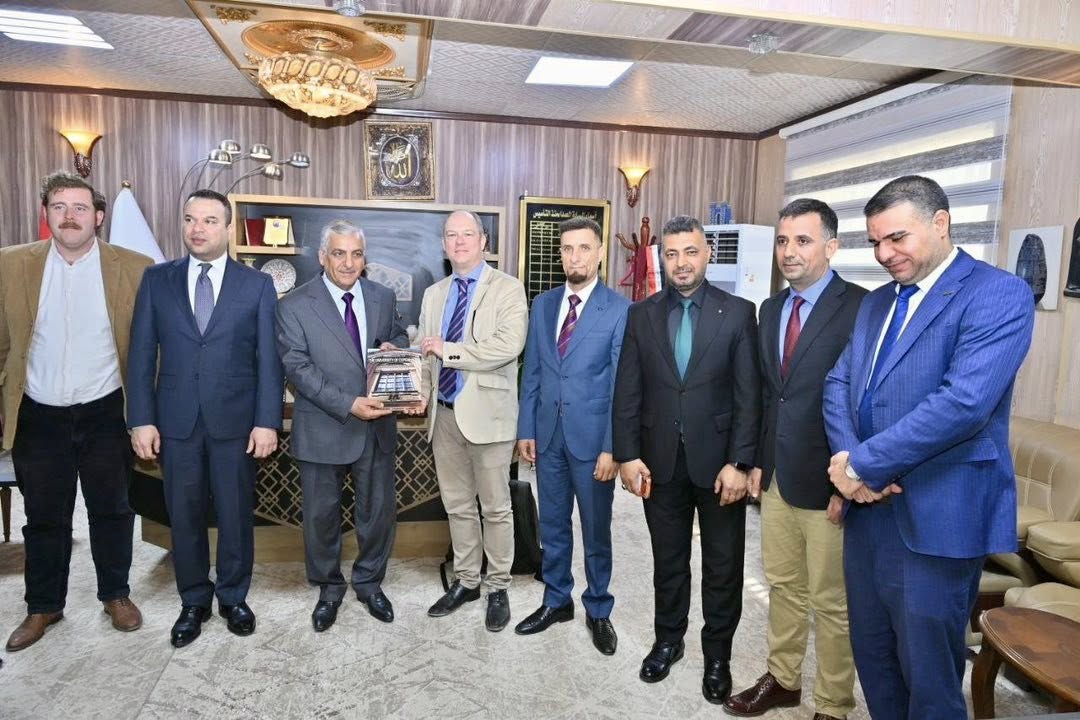
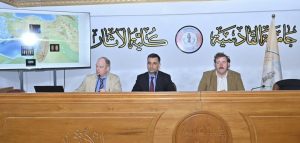
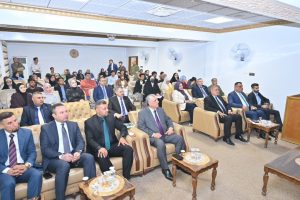
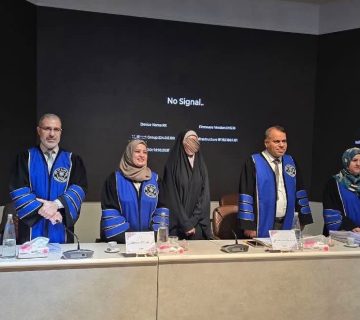
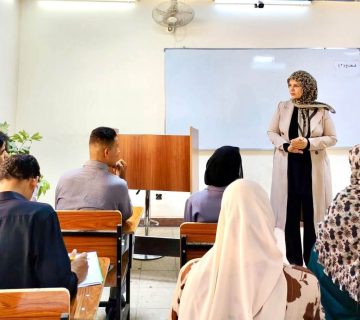
The College of Archaeology at Al-Qadisiyah University held an international workshop entitled: (The Importance of Archaeological Sites in the Western Iraqi Desert). The workshop was attended by the University President, the Vice President for Scientific Affairs, Professor Dr. Sattar Abdul-Hassan Al-Fatlawi, the Director of the Department of Missions and Cultural Relations, Dr. Asmaa Abdul-Amir Abis, and a number of professors, researchers, and students.
The workshop featured presentations by:
– Dr. Muntaser Sabah Al-Shamkhi Al-Hasnawi, Director General of the Conference Palace, Ministry of Culture, Tourism, and Antiquities, and member of the National Committee for Climate Change. – Dr. Tobias Rechger – Department of Archaeology, University of Copenhagen
– Dr. Joseph Rowe – Department of Archaeology, University of Copenhagen
– Professor Dr. Jaafar Hamza Al-Jawdhari – Department of Archaeology, College of Archaeology, University of Al-Qadisiyah
The workshop addressed the scientific and cultural significance of the archaeological sites scattered throughout the western Iraqi desert, as a material record documenting patterns of human settlement, economic movements, and historical road networks across the ages. It also discussed the effects of climate change, particularly wind erosion, dust storms, and temperature fluctuations, on the stability and integrity of the stratigraphic structure of these archaeological sites.
The workshop also addressed contemporary challenges related to heavy surface oil exploration, including the construction of road networks and geological survey routes covering vast areas, which may intersect with unregistered archaeological sites, exposing them to the risks of unintentional erosion or obliteration. The workshop aimed to highlight the necessity of adopting advanced scientific methodologies for surveying and documenting archaeological sites in desert environments, and to enhance integration between academic institutions and relevant executive bodies to ensure the protection of national cultural heritage.
The workshop concluded with several recommendations:
• The necessity of conducting comprehensive and proactive archaeological surveys in oil concession areas before commencing any exploration activities.
• Including archaeological impact assessment among the procedural requirements for oil projects and infrastructure.
• Adopting modern technologies for non-destructive exploration of archaeological sites, particularly in vast desert environments.
• Strengthening scientific cooperation between Iraqi universities and international research institutions in the field of desert cultural heritage management.
• Developing specialized training programs for archaeology students in desert surveying and environmental risk management for archaeological sites. The workshop comes as a scientific approach that seeks to achieve a balance between the requirements of economic development and the protection of cultural heritage, within a national framework that preserves the cultural identity and safeguards the material evidence for future generations.

No comment