
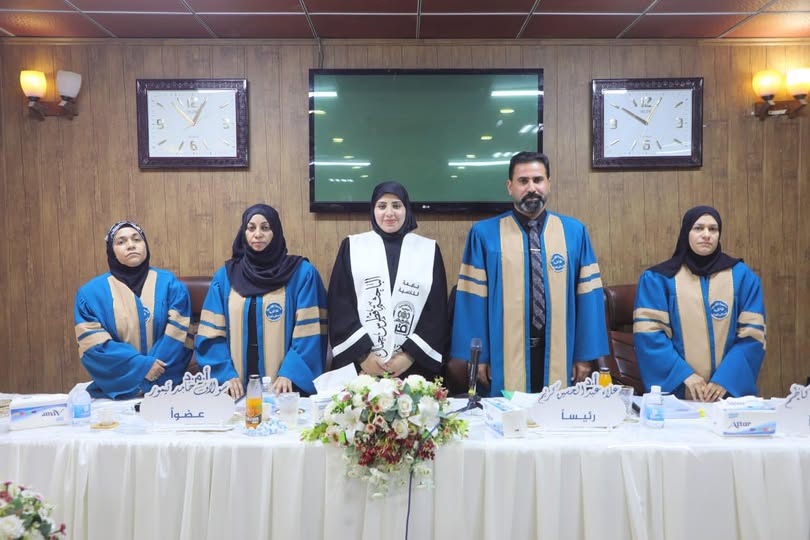
A master’s thesis was discussed in the Department of Life Sciences, College of Education, Al-Qadisiyah University, by researcher Qatras Jamal Khadir Matar, under the supervision of Assistant Professor Dr. Ibtisam Thamer Jaaz. The thesis aimed to isolate and identify contaminating fungi associated with mobile devices, identifying them morphologically and microscopically, as well as conducting sensitivity tests for antibiotics and some solutions against the fungus A. terreus. The most important conclusions were: 10 saprophytic fungal genera were isolated from mobile phones, most of which were Aspergillus. Male phones were more contaminated than female phones. The fungus A. terreus possesses a high virulence that enables it to attack humans. It is capable of hemolyzing blood, producing the enzyme urease, forming biofilm, and degrading proteins. The most important recommendations are to expand the study to include external earphones and other accessories, to use the antibiotic econazole to treat infections caused by the fungus A. terreus, and to raise awareness of the risks of fungal contamination on mobile phones.
Genetic characterization of some virulence factors of the fungus contaminating mobile devices. A master’s thesis
-
PreviousThe effect of genetic polymorphisms (SNPs) of interleukin-13 and interleukin-9 and their serum levels on the response of patients with chronic sinusitis to treatment. A master’s thesis
-
NextA PhD. thesis at the College of Medicine, Al-Qadisiyah University, discussed the distribution of some virulence determinants and their association with multidrug resistance (XDR) in bacteria causing urinary tract infections isolated from immunocompromised patients.

No comment